
What Is a Verified Professional Profile? How to Prove Your Experience Beyond a Resume
A verified professional profile is a record of your work in which each claim about what you did is backed by evidence from the work itself and confirmed by the organisation named on it. It is not the same as a verified badge on LinkedIn, Instagram or Facebook, which confirms who you are, or a digital credential, which confirms you passed a course or exam. To build one, pick three claims, attach one or two artifacts to each, add context, and ask someone who saw the work to confirm it.
What is a verified professional profile?
A verified professional profile has three parts, and it needs all three.
- A claim. A specific statement about past work, such as "made payment webhook retries idempotent" or "ran on-call for the checkout team for 18 months" (both hypothetical). "Strong backend skills" is not a claim. It is an adjective.
- An artifact. Something the work produced: a runbook, a decision note, a patch or diff, a load-test file, a demo, a design doc. You can probe an artifact in an interview.
- A confirmation. Someone at the organisation named on the claim, usually a manager or colleague who saw the work, says the claim is accurate.
"Verified" here describes the work, not the person. A profile can pass an identity check and still contain no verified work at all.
How is it different from a verified badge, a digital credential or a background check?
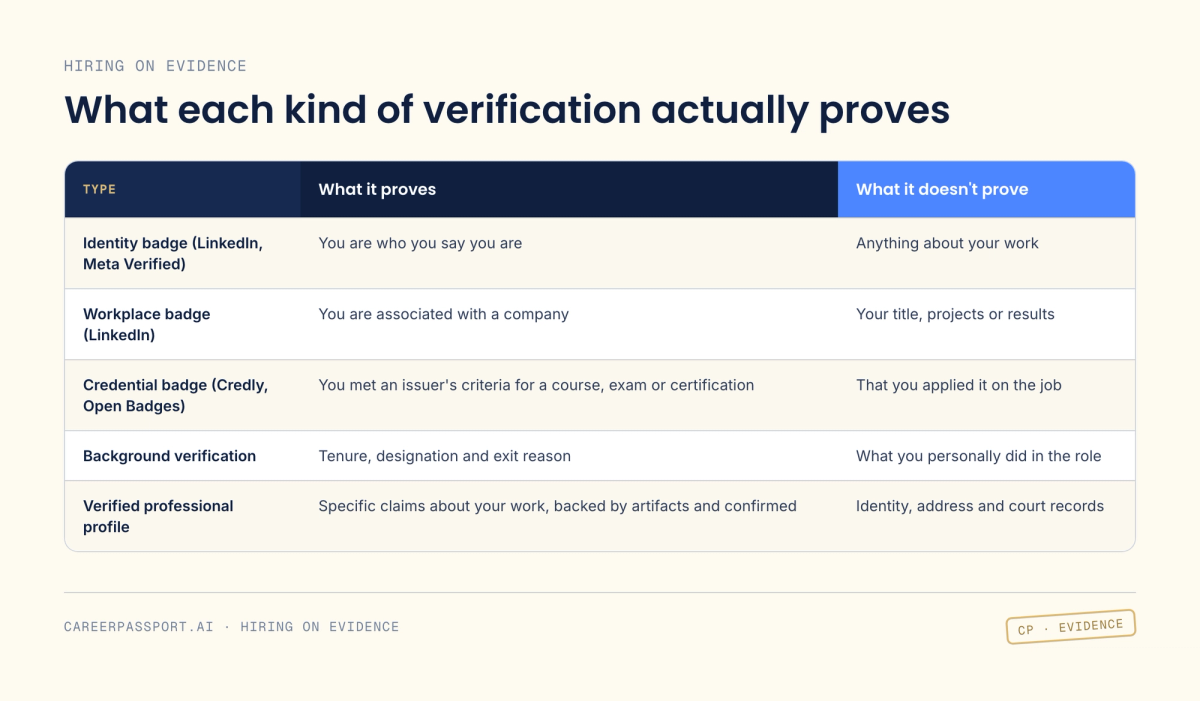
People use "verified" for four different things. Each proves something real. Only one proves what you did.
Identity verification badges. Meta described its Meta Verified badge at launch as "confirming you're the real you and that your account has been authenticated with a government ID" (Meta). Meta's current page says the badge means a profile "was verified by Meta based on your activity across Meta technologies, or information or documents you provided" (Meta Verified). On LinkedIn, identity verification means a member's government-issued ID was verified by one of LinkedIn's verification partners. In India, LinkedIn says it is available to members with DigiLocker credentials that meet certain other requirements (LinkedIn Help).
Workplace badges. LinkedIn's workplace verification means a member "has confirmed their association with the specific company" using a work email, Microsoft Entra Verified ID, a LinkedIn Learning licence from their company, or an active LinkedIn Recruiter licence. Work-email verification is only available at select companies, and the email must match the current company's domain (LinkedIn Help). It doesn't confirm your title or results.
Credential badges. Credly describes a digital badge as "a tangible representation of an individual's competencies and skills," typically carrying the earner's name, the issuing organisation and the criteria met (Credly). Credly follows the Open Badges standard, which 1EdTech says describes "who earned it, who issued it, and the criteria required," and can contain evidence (1EdTech). A credential badge proves you met an issuer's criteria for a course, exam or certification. It doesn't prove you applied it on the job.
Employment and background verification. In India, employment checks confirm "tenure of past employment, designation, salary details (if needed), reason for exit," and the process "typically begins after a conditional offer" (OnGrid). It confirms the record, not the work.
Which platforms offer a verified professional profile today?
Most platforms verify one layer. LinkedIn verifies identity, workplace and educational institution. Credly verifies credentials. GitHub shows public code well, but private repository activity can only be shown with "specific details of your activity in private repositories anonymized" (GitHub Docs). For most engineers, whose best work sits in private company repositories, the contribution graph shows that you were busy, not what you built. Background verification vendors confirm dates and designation after the offer.
Confirming the claims themselves is the gap. That is the layer CareerPassport is built for (we build CareerPassport): each claim is backed by artifacts and confirmed by the organisation named on it. You can also assemble the same evidence yourself.
Why isn't a resume enough anymore?
A resume is a list of unconfirmed claims, and employers know it. AuthBridge's analysis of background verification data from October 2024 to March 2025 found a 6% discrepancy rate for white-collar employees and 9.46% in IT/ITES, where "inflated job titles and exaggerated tenures" were common red flags (SMEStreet).
If you are an engineer whose real work is in private repos and internal wikis, your resume reads the same as an inflated one. Evidence is what separates them.
How can a software engineer prove their experience beyond a resume?
Show the work, in small, checkable pieces. These artifact types work well, and each proves something specific:
- Runbook you wrote: you operated the system, not just built it.
- Decision note or design doc: your reasoning and the trade-offs you weighed.
- Patch or diff (redacted, or a public open-source pull request): depth at the code level.
- Load-test file or benchmark: you measured the impact instead of guessing.
- Failure timeline or postmortem: how you behave when things break.
- Demo (a short screen recording): the thing you shipped works.
One artifact with a clear context note beats a big portfolio no one reads.
How do you build an evidence pack in a weekend?
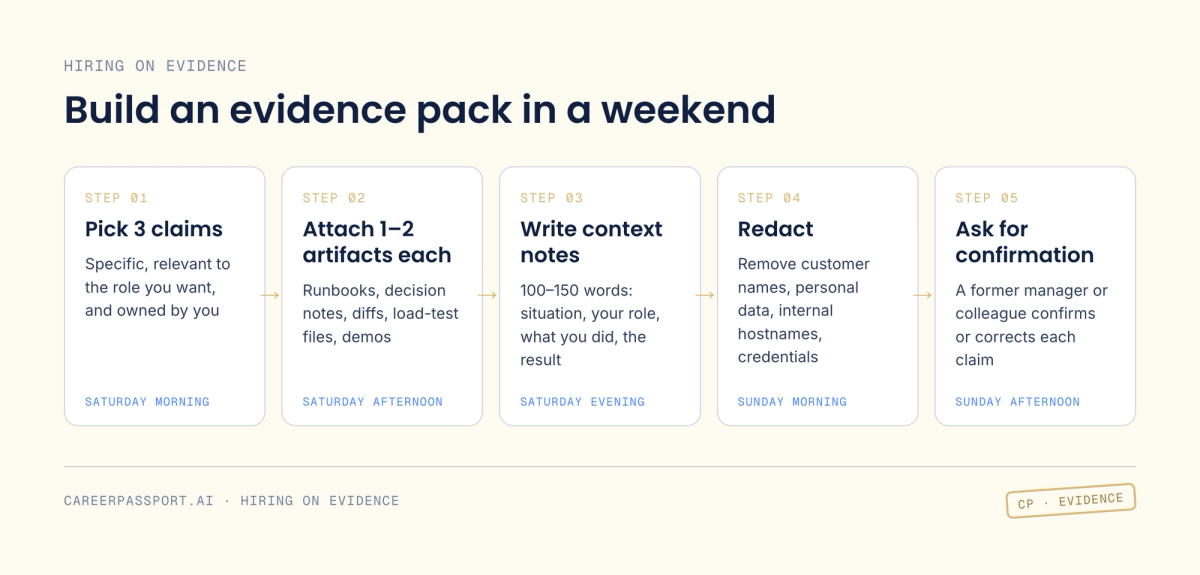
An evidence pack is a short, shareable set of claims, each with artifacts and a confirmation. Here is a two-day plan.
- Saturday morning: pick 3 claims. Choose claims that are specific, relevant to the role you want, and owned by you. Write each as one sentence: what you did, and the result. Use a number only if you have it and are allowed to share it.
- Saturday afternoon: attach 1–2 artifacts each. Good types: runbooks, decision notes, diffs, load-test files, demos. Search old pull requests, wiki pages, design docs and personal notes. If the original can't leave the company, write a fresh version from memory and label it "reconstructed".
- Saturday evening: write context notes. 100–150 words per claim: the situation, your role, what you did, the result, and what you'd change.
- Sunday morning: redact. Remove customer names, personal data, internal hostnames, credentials and exact revenue figures. Replace numbers with ranges or relative changes. Check your employment agreement. If in doubt, describe the artifact instead of sharing it.
- Sunday afternoon: ask for confirmation. Send a former manager or colleague who saw the work the claim and the context note. Ask them to confirm or correct each claim in writing. Record their name, their role at the time and the date.
Copy this structure for each claim:
``` CLAIM: [what you did] + [result], [company], [dates] MY ROLE: owner / co-owner / contributor ARTIFACTS:
- [type] | [file or link] | [what it shows]
- [type] | [file or link] | [what it shows]
CONTEXT NOTE (100–150 words): situation, what I did, result, what I'd change REDACTIONS: [e.g. customer names, internal hostnames, exact revenue] CONFIRMED BY: [name], [role at the time], [how they saw the work], [date] ```
A hypothetical example: a backend engineer at a Bengaluru fintech claims she "made payment webhook retries idempotent, ending duplicate refunds after two incidents." Her artifacts are a redacted idempotency-patch.diff and a failure-timeline.md. Her former engineering manager confirms the claim and adds one correction: the second incident was caught in staging, not production. That correction makes the claim more credible, not less.
How do you check whether a senior hire's profile claims are real?
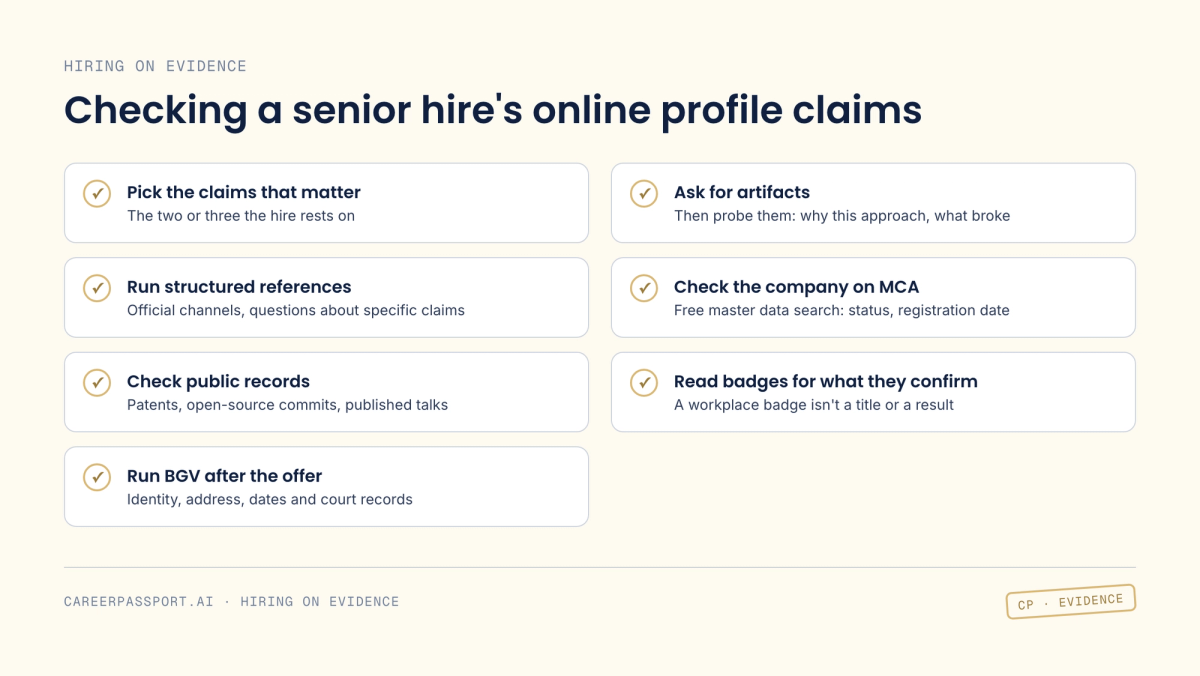
Hiring managers can apply the same structure in reverse: verify the claims the hire rests on, not the whole profile.
- Pick the claims that matter. The two or three that justify the level and the pay.
- Ask for artifacts, then probe them. Why this approach? What broke? What would you change? People who did the work answer these quickly and in detail.
- Run structured references. Reach referees through the company's official channels, not only the number the candidate gave. Ask about the specific claim: "What did he own on the migration?"
- Check the company on MCA. The MCA master data search on mca.gov.in is free, needs no login, and shows the CIN, registration date and status, such as Active or Strike Off (Industax). Confirm the company existed and was active during the claimed tenure.
- Check public records. For a claimed patent, search Google Patents, which "includes over 120 million patent publications from 100+ patent offices around the world" (Google). Open-source commits and published talks can be checked the same way.
- Read badges for what they confirm. A workplace badge isn't a title or a result.
- Run BGV after the offer for identity, address, dates and court records.
For the full India sequence, including EPFO service history, Form 16 and DPDP consent, see how to verify a candidate's work experience in India.
How CareerPassport builds a verified professional profile
CareerPassport turns the evidence pack into a standing profile. Each professional gets a CareerPassport with an Experience Visa for every role: skills, projects, endorsements and impact. Claims are backed by artifacts as evidence, such as runbooks, decision notes, patches and diffs, load-test files and demos. Stamps are earned when the evidence shows real depth.
CareerPassport pulls in what you already have: your CV, LinkedIn, GitHub, writing, projects, documents and demos. An AI companion helps you document the work by asking questions about it. And the record is yours: "Nothing here can be edited by anyone else."
CareerPassport is early. Professionals can join the waitlist at careerpassport.ai.
For hiring managers, CareerPassport for companies runs the role with an agent that collects evidence from candidates, with every claim confirmed by the organisation named on it, and returns a shortlist "cleared to meet." You decide who to invite. Book a free 30-minute demo.