
How to Verify a Candidate's Work Experience in India
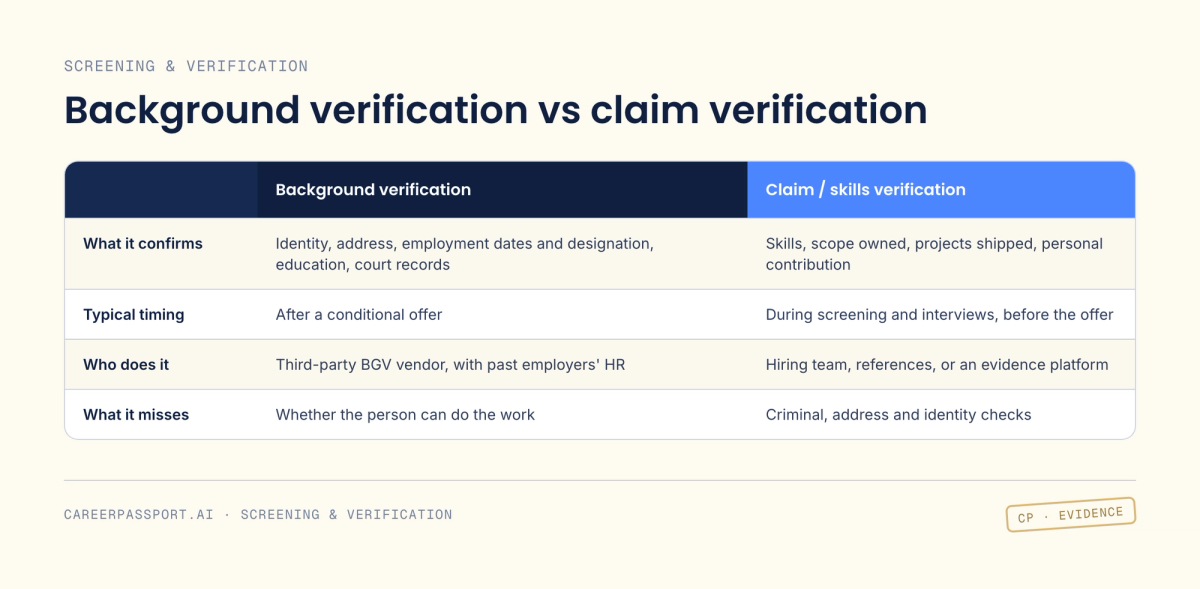
In India, standard background verification (BGV) confirms that a candidate worked where they say, when they say, and checks identity, address, education and court records. It usually starts after a conditional offer, and it does not tell you what the person actually did in the role. Verify the claims that matter (scope, skills, projects, contribution) early in the funnel with evidence and the candidate's consent, and keep formal BGV as the post-offer gate.
What does a standard background check in India verify?
Background verification is a set of checks, usually run by a third-party vendor, that confirms facts a candidate has stated. A typical Indian package, as described by OnGrid, covers:
- Identity: Aadhaar, PAN and other ID matched against government records.
- Address: digital, postal or physical verification of current and permanent address.
- Employment history: designation, tenure, exit reason and conduct, confirmed with the previous employer's HR team.
- Education: degree, completion status and marks.
- Criminal and court records: searches of court and police databases.
- Optional extras: credit, references, global database and media checks.
For employment checks, vendors combine sources. SpringVerify lists direct HR contact, PF/EPFO records, MCA company registration data and TAN verification, and puts the industry average at "5–14 working days."
These checks catch real problems. AuthBridge's Workforce Fraud Files 2025, covering October 2024 to March 2025, found a 6% discrepancy rate for white-collar employees. IT/ITES had a 9.46% rate, with "inflated job titles and exaggerated tenures" among the common red flags (SMEStreet).
What doesn't a background check tell you?
BGV confirms the record. It doesn't confirm the work. An HR team can say "Senior Engineer, April 2021 to June 2024, eligible for rehire." It won't say whether the candidate led the payments migration on their resume or sat beside the person who did.
So a clean BGV leaves three questions open:
- Skills: can they do the thing the role needs?
- Scope: did they own the outcome, or contribute to it?
- Contribution: what did they personally decide, build or fix?
Skills verification and claim verification fill that gap. A claim is any specific statement about past work ("cut p95 latency by half", "ran vendor onboarding for 40 stores"). Verifying it means getting evidence from the work itself or from someone who saw it.
Why is post-offer verification too late?
OnGrid notes that BGV "typically begins after a conditional offer of employment is extended." By that point you have finished interviews, negotiated pay and probably closed out your other candidates. The candidate may have resigned and started serving notice.
If a discrepancy surfaces now, you rescind an offer and restart the search, often weeks later. And BGV may still pass someone whose dates are true and whose claims are inflated. Checking claims earlier costs less and catches more.
How can a hiring team verify work experience before the offer?
You don't need a vendor for the first pass. With the candidate's consent, run these five checks.
- EPFO service history. The EPFO Unified Member Portal has a Service History section showing a member's employers, dates of joining and exit, and EPF and pension records linked to their Universal Account Number (UAN), the lifetime ID that ties together PF accounts across jobs. The member logs in with UAN, password and OTP and can download the record (Business Today). Ask the candidate to share the download. Never ask for their password or OTP. Know the limit: PF registration is mandatory for firms with 20 or more employees (Wikipedia), so small startups, consulting, freelance and overseas work may be missing. A gap is a question to ask, not proof of fraud.
- Form 16 and payslips. Form 16 is the employer's TDS certificate for salary. Under the Income-tax Act, 2025 it is replaced by Form 130 from 1 April 2026; Form 16 still applies for FY 2025-26 and earlier (TaxGuru). Part A shows the employer's name, PAN and TAN and the period of employment. Match the employer name and dates against the resume and EPFO record.
- Does the employer exist? The Ministry of Corporate Affairs master data search on mca.gov.in is free, needs no login, and shows whether a company exists and is active (Industax). Compare its registration details with the dates claimed.
- Reference calls done well. Reach the referee through the company's switchboard or official email, not the number the candidate gave. Ask about specifics: "What did she own on the warehouse rollout? What would you not give her yet?" Ask for one example of a decision they made. Vague praise is weak evidence; a concrete story is strong evidence.
- Work artifacts. Ask for evidence of the claims that matter for the role: a design doc, a public repository, a deck with confidential numbers removed, a demo. Don't push anyone to share a former employer's confidential material. Then use the interview to probe the artifact: why this approach, what broke, what they'd change.
What are the red flags on a fake experience letter?
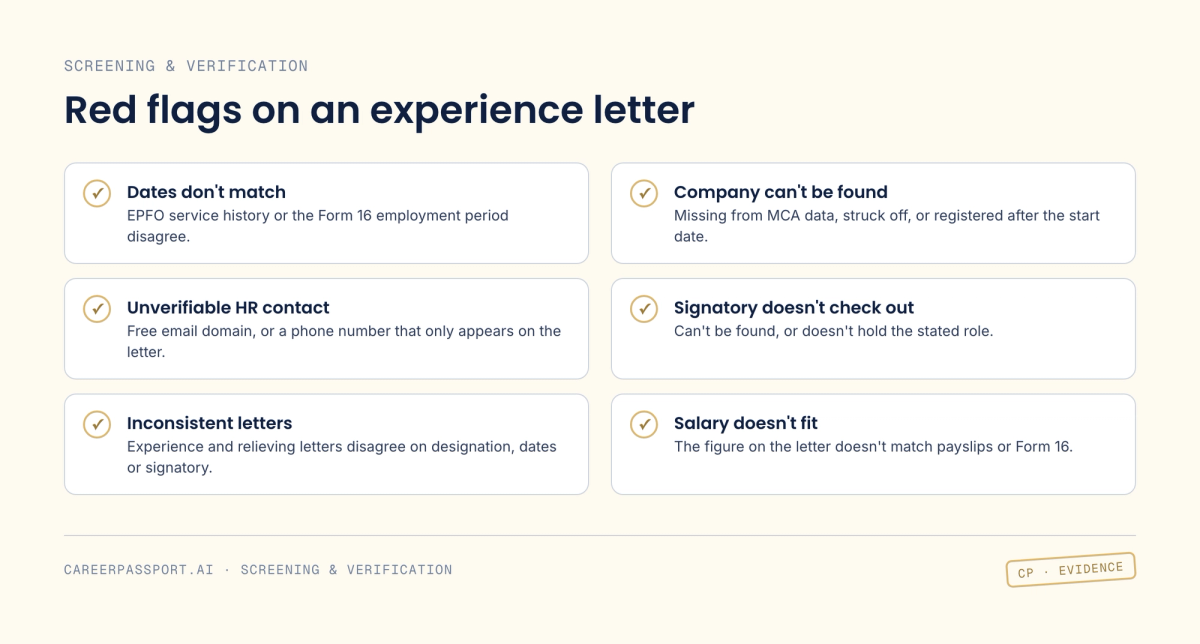
Treat the letter as a claim, not as proof. Watch for:
- Dates that don't match EPFO service history or the Form 16 employment period.
- A company that can't be found on the MCA master data, is struck off, or was registered after the claimed start date.
- An HR contact on a free email domain, or a phone number that only appears on the letter.
- A signatory who can't be found or doesn't hold the stated role.
- Experience and relieving letters with inconsistent designations, dates or signatories.
- A salary on the letter that doesn't fit the payslips or Form 16.
- No registered address or reference number, inconsistent fonts, or obvious template text.
One flag can be innocent. Two or more, especially a date mismatch, warrant a direct conversation before you go further.
What does India's DPDP Act require when you verify candidates?
The Digital Personal Data Protection Act, 2023 (DPDP Act) governs how organisations handle digital personal data. Parliament enacted it on 11 August 2023, and the DPDP Rules were notified on 14 November 2025 with an 18-month phased rollout (PIB). Notice and consent requirements, security safeguards and data principal rights apply from May 2027, at the end of that 18-month window (Shardul Amarchand Mangaldas). They aren't enforceable yet, but hiring processes built today will be running when they are.
What the Act's text says, in short:
- Notice first. A consent request must come with a notice stating the personal data and the purpose (Section 5).
- Real consent. Consent must be "free, specific, informed, unconditional and unambiguous with a clear affirmative action," limited to data needed for that purpose (Section 6(1)).
- Withdrawal. Candidates can withdraw consent at any time, as easily as they gave it (Section 6(4)).
- Erasure. Data must be erased when consent is withdrawn or the purpose is no longer served, unless law requires retention (Section 8(7)).
Section 7(i) allows processing without consent "for the purposes of employment." But the Act is silent on whether shortlisting, interviews or background checks count, as Bar & Bench points out. Until that is clarified, take explicit consent for each stage of checking.
The PIB summary lists penalties of up to ₹250 crore for failing to maintain reasonable security safeguards. Teams hiring in the US will recognise the pattern: the FTC requires written permission before an employer gets a background report.
Background verification vs claim verification: what's the difference?
Do you need both, and in what order?
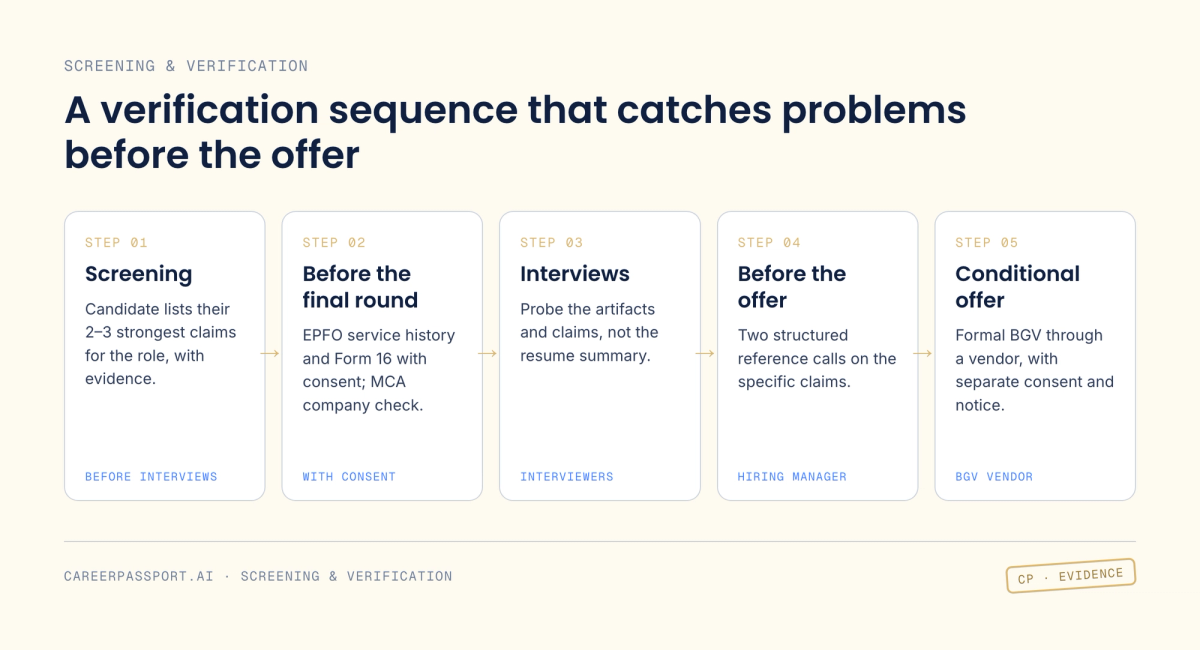
Most roles need both. They answer different questions. A practical sequence:
- Screening: ask candidates to list their two or three strongest claims for this role, with evidence.
- Before the final round: collect EPFO service history and Form 16 with consent; run the MCA check.
- Interviews: probe the artifacts and claims, not the resume summary.
- Before the offer: two structured reference calls on the specific claims.
- Conditional offer: formal BGV through a vendor, with a separate consent and notice.
- After a hiring decision: delete documents of candidates you didn't hire once the purpose is served.
This puts the checks that most often change your decision ahead of the offer, and leaves the compliance checks where they belong.
How CareerPassport moves verification earlier
CareerPassport is built on the idea that evidence should arrive with the candidate, not after the offer. Professionals (now joining through a waitlist) build a CareerPassport with an Experience Visa for every role: skills, projects, endorsements and impact. Claims are backed by artifacts such as runbooks, decision notes, patches and diffs, load-test files and demos, and every claim is confirmed by the organisation named on it.
For hiring teams, CareerPassport for companies turns one brief into a hiring blueprint, runs the role with an agent that collects evidence from candidates, and returns a shortlist "cleared to meet." You decide who to invite. Recruitment partners get a pipeline with an evidence score per candidate, built on their own private candidate database, through CareerPassport for recruitment partners.
That doesn't replace your post-offer BGV for identity, address and criminal records. It means the claim questions are answered before anyone books an interview. Book a free 30-minute demo to see an evaluation summary.