
Best AI Resume Screening Tools in India (2026)
The best AI resume screening tool for an Indian hiring team is the one that gives a reason for every shortlist decision, not just a match score. For an ATS with an India focus, start with Zoho Recruit (rupee pricing) or Keka Hire (Naukri integration); for written reasoning behind each score, look at Workable or CVViZ; for tech roles, HackerEarth's Screening Agent; for very high volumes, TurboHire. CareerPassport (which we build) collects evidence before interviews and returns a shortlist "cleared to meet".
How did we choose these tools?
Deloitte India's Campus Workforce Trends 2026, a survey of 257 organisations, found that "72 percent of organisations use AI for resume screening", the most common AI use case in recruitment (Deloitte India, 27 Aug 2026). The question is which tool.
We picked ten tools using five criteria:
- It screens or ranks candidates against the role, not only parses CVs into fields.
- It serves India: an Indian company, rupee pricing, an Indian office, or a Naukri integration shown on the vendor's own pages.
- It shows how it decides: per-criterion scores, written reasoning, highlights or evidence.
- A person stays in control: recruiters can review, override or reject the tool's decisions.
- Its facts are public: every feature and price below comes from the vendor's own site, checked October 2026 (20 October 2026). Prices change, so confirm before you buy.
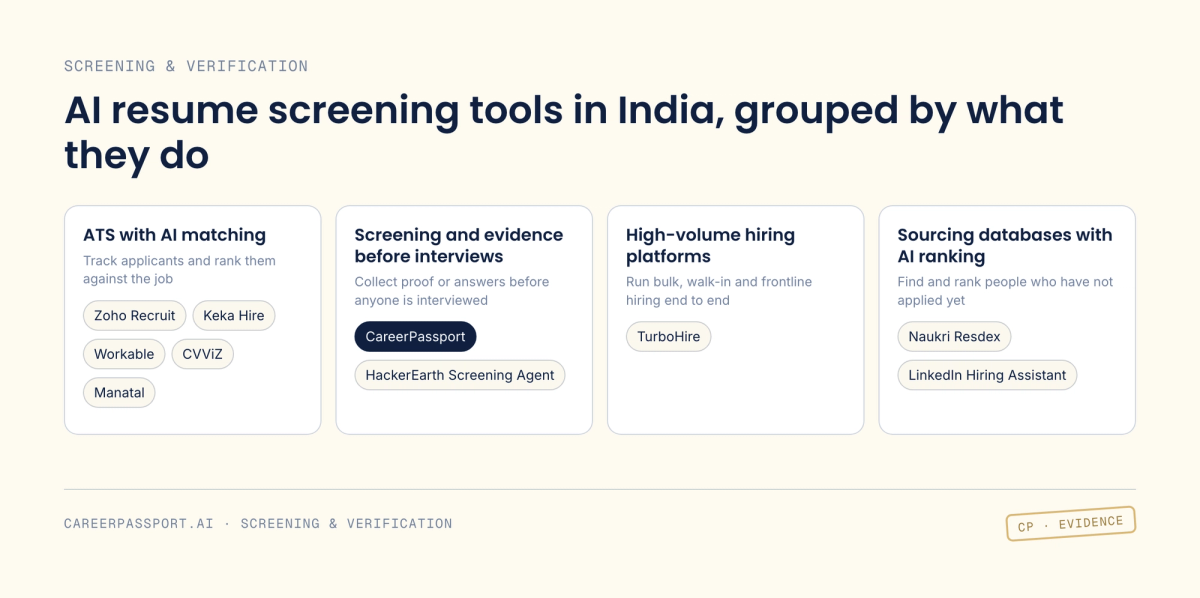
The ten tools fall into four groups:
- ATS with AI matching: track applicants and rank them against the job. Zoho Recruit, Keka Hire, Workable, CVViZ, Manatal.
- Screening and evidence before interviews: collect proof or answers before anyone is interviewed. CareerPassport, HackerEarth Screening Agent.
- High-volume hiring platforms: run bulk, walk-in and frontline hiring end to end. TurboHire.
- Sourcing databases with AI ranking: find and rank people who have not applied yet. Naukri Resdex, LinkedIn Hiring Assistant.
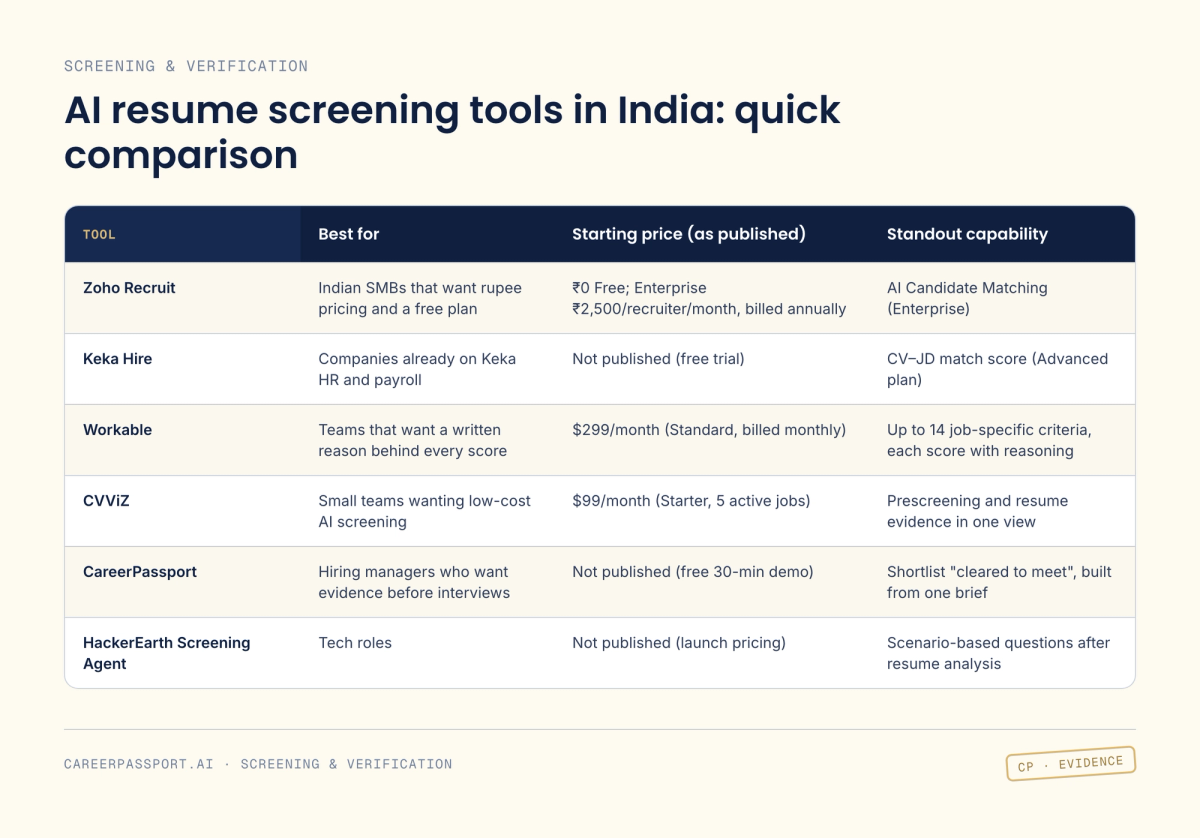
Quick comparison: AI resume screening tools in India
What is the difference between keyword parsing and explainable AI screening?
Four terms get mixed up in vendor copy:
- Resume parsing turns a CV file into structured data. Zoho, for example, describes its parser as turning resumes into data on "skills, experience, education, personal/contact information, and more".
- Keyword matching ranks CVs by how many of the job's terms they contain. Naukri's own Resdex guide tells recruiters to "Think like a candidate writing a resume, not like a recruiter writing a JD."
- A match score is one number, such as 82%, for how well a CV fits a job.
- Explainable screening breaks that number into criteria and gives a reason for each. Evidence-based screening goes further and collects proof, such as answers to role-specific questions or work samples, before an interview.
Why does a reason for every shortlist decision matter?
- You can check a reason; you cannot check a number. If the tool says "shortlisted: led a payments migration, matches the system design criterion", a recruiter can verify it in two minutes. An 82% gives them nothing to verify.
- Keywords are cheap now. HackerEarth's screening page says traditional keyword-based screening "often rewards candidates who stuff resumes with buzzwords". With AI-written CVs everywhere, the words match even when the experience doesn't. We cover this in how to screen candidates when every resume is AI-written.
- Hiring managers stop re-screening. They review reasons instead of re-reading every CV, and fewer weak candidates reach interviews.
- The law expects accurate decisions. Under Section 8(3) of India's Digital Personal Data Protection Act, 2023, where personal data is likely to be "used to make a decision that affects the Data Principal", the organisation must "ensure its completeness, accuracy and consistency". A readable reason is how you spot a decision built on wrong data.
The best AI resume screening tools in India (2026)
The list is ordered by fit for the most common situation we see: an Indian company with a small recruiting team, hundreds of applicants per role, and a hiring manager who wants to know why each person was shortlisted. Sourcing databases come last because they find people rather than screen applicants.
1. Zoho Recruit
Zoho Recruit is an applicant tracking system whose Enterprise plan offers "AI-powered recruitment for custom automation and hiring in bulk", priced in rupees for Indian teams.
Key features
- Its resume parser handles DOC, PDF, RTF and TXT files and matches parsed resumes against existing profiles to prevent duplicates.
- Recruiters choose Lenient, Moderate or Strict parsing modes and can review and edit parsed data.
- AI Candidate Matching is listed in the Enterprise plan.
- Zoho says recruiters can use AI profile summaries and assessment generation to screen candidates faster.
Best for: Indian SMBs and mid-size companies that want rupee pricing and a free plan to start.
Pricing: Free at ₹0 (1 active job per recruiter license); Standard ₹1,250 and Enterprise ₹2,500 per recruiter per month, billed annually; local taxes such as GST are extra (Zoho Recruit pricing).
Watch out for: AI Candidate Matching sits in Enterprise, not Standard.
2. Keka Hire
Keka Hire is Keka's applicant tracking system, covering hiring "from sourcing to onboarding" alongside Keka's HR and payroll products.
Key features
- AI Resume Scoring: Keka says automated profile scoring brings best-fit candidates to the top "without anyone reading every resume" (Keka Hire).
- The Advanced hiring plan adds a "Candidate CV - JD match score" for shortlisting.
- It integrates with job boards "such as LinkedIn, Naukri, and more" and with assessment platforms such as Mettl Mercer and HackerEarth.
Best for: companies already on Keka for HR and payroll, or that want one Indian vendor for both.
Pricing: Not published. The pricing page shows Pro and Advanced hiring plans with a free trial but no price.
Watch out for: the CV–JD match score is listed under Advanced, not Pro.
3. Workable
Workable is an applicant tracking system with a built-in AI agent that scores candidates against criteria specific to your job and gives reasoning for each score.
Key features
- The agent evaluates "up to 14 criteria specific to your job", each scored independently and normalised to a 0–100 scale (Workable Agent).
- Workable says: "Every score has reasoning. Every candidate action is logged."
- Recruiters can "Review, override or reject any decision instantly", and the agent stops once you engage a candidate.
- A Naukri integration brings Naukri applicants into Workable's Applied stage.
Best for: teams that want a written reason behind every score.
Pricing: Standard is $299/month billed monthly or $3,588/year, at the default 1–20 employee setting; each plan includes 3,000 complimentary AI credits, and the Screening Agent uses AI credits (Workable pricing).
Watch out for: pricing is in US dollars, and the Naukri integration needs "a paid Naukri subscription and the integration module, which has an additional cost".
4. CVViZ
CVViZ describes itself as "a modern recruiting software that uses artificial intelligence to help you hire faster"; the company is CVViZ Softwares Pvt Ltd and lists a +91 contact number.
Key features
- "Contextual role-to-resume matching" that ranks relevance against the role context (CVViZ).
- "Prescreening and resume evidence in one view."
- CVViZ says recruiters "retain control of criteria, review the evidence and make the hiring decision".
- An "Integrate" plan offers resume screening, matching and ranking at $25 per job.
Best for: small teams that want AI screening at a low monthly cost with unlimited users.
Pricing: Starter $99/month (5 active jobs, unlimited users), up to Pro at $499/month (100 active jobs); 7-day free trial (CVViZ pricing).
Watch out for: prices are in US dollars, and Starter is capped at 5 active jobs.
5. CareerPassport
We build CareerPassport.
CareerPassport is an evidence-led hiring platform that turns a hiring manager's brief into an evaluation plan, collects evidence before interviews and returns a shortlist "cleared to meet".
Key features
- One brief becomes a hiring blueprint: technology requirements, expertise level and an evaluation matrix chosen from nine competencies (Reasoning, Prioritization, Judgment, Expertise, Execution, Initiative, Communication, Collaboration, Alignment).
- An agent draws candidates from the company's own database, recruitment partners and CareerPassport profiles, approaches them, for example by email, and collects evidence.
- The hiring manager stays in control: invite, reject, or view the evaluation summary.
- "Every claim confirmed by the organisation named on it."
Best for: hiring managers, especially for tech roles, who want evidence rather than a match score before spending interview time.
Pricing: Not published. Companies book a free 30-minute demo.
Watch out for: CareerPassport is early. Companies start by booking a demo or posting a role, and the professional side is still a waitlist.
6. HackerEarth Screening Agent
HackerEarth's Screening Agent combines "intelligent resume analysis with dynamic questioning" to find candidates who fit a role, with a focus on technical hiring; HackerEarth lists an office in Bengaluru.
Key features
- Personalised questions based on resume content and job requirements (HackerEarth Screening Agent).
- "Scenario-based inquiries tailored to the specific job description" to test technical depth.
- Red flag detection for "inflated experience, vague explanations, or contradictions between stated skills and demonstrated ability".
- Candidates get a link to complete the screening interview "anytime, 24/7", with no scheduling.
Best for: engineering and tech roles where the CV alone tells you little.
Pricing: Not published. The page shows "Exclusive Launch Pricing" for Growth and Scale plans without prices.
Watch out for: Growth includes 1 admin; ATS integrations are listed only in Scale.
7. TurboHire
TurboHire is an "AI-Native Recruitment Execution Platform" for high-volume hiring, built around a SuperAgent that "runs hiring end-to-end".
Key features
- Its evaluation step screens candidates "consistently across roles using defined criteria so quality does not vary" (TurboHire).
- Configured for white-, grey- and blue-collar roles in sectors including BFSI, BPO/KPO walk-in hiring, GCCs, retail and QSR.
- Integrations for assessments, background verification, job boards, HRMS and eSign.
Best for: large employers hiring hundreds of frontline, field or fresher roles at once.
Pricing: Not published; TurboHire offers a demo and says setup takes 2 weeks.
Watch out for: it is positioned for high-volume hiring, so a team filling a handful of roles a year should check fit in the demo.
8. Manatal
Manatal is "AI Recruitment Software designed to source and hire candidates faster", built for HR teams, recruitment agencies and headhunters.
Key features
- AI Recommendations "Score candidates' profiles based on job requirements" (Manatal).
- Candidate enrichment from 20+ social media and public platforms.
- Naukri is among its 2,500+ job board integrations.
Best for: small teams and agencies that want low per-user pricing.
Pricing: Professional $15/user/month billed annually ($19 monthly); Enterprise $35 billed annually ($39 monthly); 14-day free trial (Manatal pricing).
Watch out for: prices are in US dollars only, and Professional is limited to 15 jobs and 10,000 candidates.
9. Naukri Resdex
Resdex is Naukri's resume database that "helps recruiters find and connect with the right candidates faster", with AI ranking in its Enterprise upgrade.
Key features
- Keyword and Boolean search with mandatory and exclude keywords, plus filters for experience, location, salary and notice period (Naukri's Resdex guide).
- Resdex Enterprise adds "Personalized ranking" based on skills, experience, role relevance and past interactions.
- "AI-generated candidate highlights" summarise role fit, experience relevance and notable skills.
- The PremiumX add-on shows "Checked Profiles" with verified company, CTC and notice period.
Best for: sourcing Indian candidates at volume.
Pricing: Not published on public pages. Resdex runs on a CV quota: viewing a profile uses 1 quota, and an Excel download uses 2.
Watch out for: it is a sourcing database rather than an applicant screener, and the AI ranking sits in the Enterprise upgrade.
10. LinkedIn Hiring Assistant
Hiring Assistant is an AI agent, sold as an add-on to LinkedIn Recruiter, that sources candidates, evaluates applicants and helps with outreach.
Key features
- LinkedIn says it "helps evaluate thousands of applicants from LinkedIn and your ATS in minutes", surfacing candidates with their relevant skills and experience (LinkedIn).
- It drafts personalised messages and pre-screens interested candidates.
- Recruiters choose projects and "remain in control throughout the process, from intake to interview."
- LinkedIn's Prashanthi Padmanabhan told Business Today that customers saw "an 80% reduction in the number of profiles recruiters need to review before deciding whom to approach"; TCS took part in the pilot.
Best for: teams already paying for LinkedIn Recruiter.
Pricing: Not published; contact sales.
Watch out for: it is an add-on to LinkedIn Recruiter, not a standalone product.
Which AI resume screening tool should you choose?
- If you hire under 10 people a year: Zoho Recruit's Free or Standard plan, or CVViZ Starter, is enough.
- If you have two recruiters and hundreds of applicants per role: an ATS with AI scoring that explains itself, such as Zoho Recruit Enterprise, Keka Hire Advanced or Workable. Pilot it on one live role.
- If you hire engineers: add a step that tests the CV. HackerEarth's Screening Agent questions candidates; CareerPassport collects evidence against an evaluation matrix.
- If you hire hundreds of frontline, field or campus roles at once: TurboHire is built for it.
- If applicants are not the problem and finding people is: Naukri Resdex and LinkedIn Hiring Assistant. Our guide to AI recruiting agents vs ATS explains when an agent beats a tracker.
- If your goal is fewer interviews per hire: pick a tool that filters before the first interview, and track how many shortlisted candidates the hiring manager agrees to meet.
What should you ask a vendor before you buy?
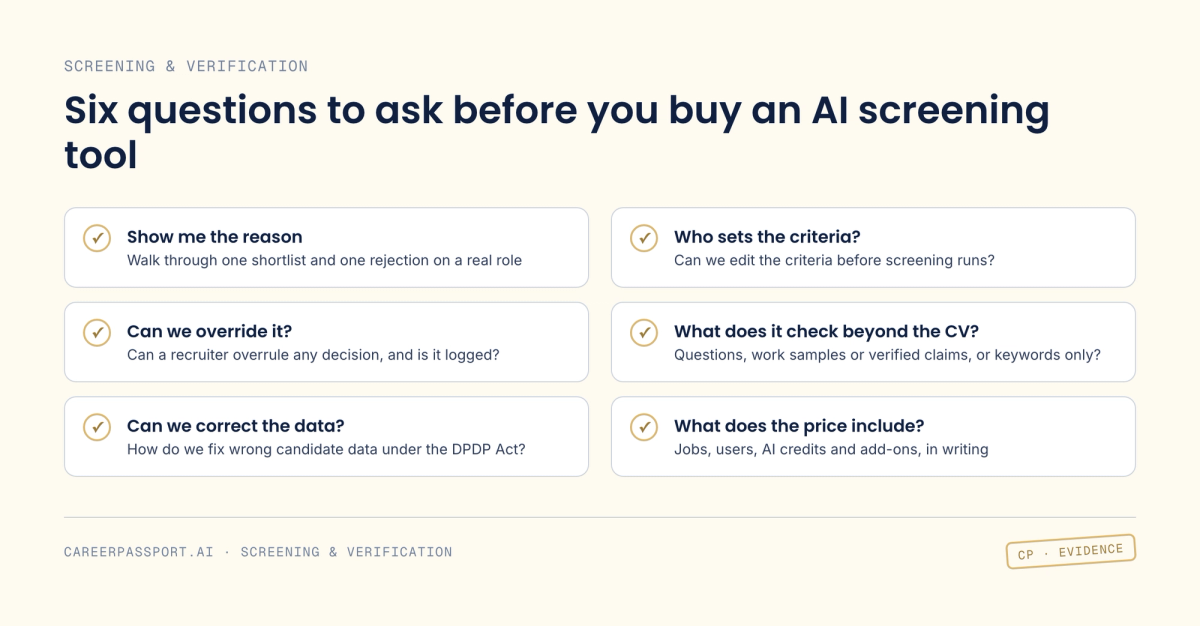
- Show me the reason. Walk through one shortlist and one rejection on a real role.
- Who sets the criteria? Can we edit the criteria before screening runs?
- Can we override it? Can a recruiter overrule any decision, and is it logged?
- What does it check beyond the CV? Questions, work samples or verified claims, or keywords only?
- Can we correct the data? How do we fix wrong candidate data under the DPDP Act?
- What does the price include? Jobs, users, AI credits and add-ons, in writing.
How does CareerPassport screen candidates?
CareerPassport starts from the brief, not the CV. The brief becomes an evaluation matrix, an agent collects evidence from candidates against it, and the hiring manager sees only a shortlist that is "cleared to meet", with an evaluation summary for each person. In CareerPassport's words: "You step in when there is a decision worth making."
See how it works on CareerPassport for companies, or book a free 30-minute demo.