
How to Screen Candidates When Every Resume Looks AI-Written
When every CV is fluent and keyword-matched, stop grading the writing and start grading the evidence. Cut volume with a few hard knockout criteria, then ask the remaining candidates for 2–3 pieces of work they have already done and a handful of short structured answers, and score all of it on one rubric before anyone books an interview. AI detectors will not fix this: they misfire, and they misfire most on non-native English writers.
Why do all resumes look the same now?
Because a large share of candidates now draft them with the same tools. In a May 2026 survey of 2,000 US adults, Novoresume found that 42.6% used AI tools when updating their resume, and 27.1% have submitted a fully AI-generated resume to a real job without significant edits.
India is heading the same way. LinkedIn research reported by Careers360 in January 2026 found that 94% of Indian job seekers plan to use AI tools in their job search, that applications per job opening in India have more than doubled since early 2022, and that nearly 74% of Indian recruiters say it has become harder to find qualified candidates over the past year.
More applications, more polish, fewer clear signals. In a Greenhouse survey of 4,136 job seekers, recruiters and hiring managers in the US, UK, Ireland and Germany, 34% of recruiters said they spend up to half their week filtering spam and junk applications.
Why does keyword screening break on AI-polished CVs?
Keyword screening means ranking CVs by how closely their text matches the terms in a job description, whether a recruiter does it by eye or an applicant tracking system (ATS) does it automatically. It used to be a rough proxy for relevance. Now a candidate can paste your job description into a chatbot and get back a CV that mirrors its vocabulary line by line. The match score ends up measuring prompting skill.
Some candidates go further. In the same Greenhouse research, 41% of 1,200 US job seekers admitted to using prompt injections, which is hidden text written to steer AI filters.
The other failure is quieter. A strong engineer who wrote her own CV in plain language, without echoing your exact phrasing, can score below a weaker candidate with a perfectly tuned one. So is AI resume screening accurate? Only as accurate as what it reads. If it reads claims, it ranks claims.
Should you run resumes through an AI detector?
No. OpenAI itself withdrew its AI text classifier: as Search Engine Journal reported, OpenAI's note said the tool was no longer available as of July 20, 2023 "due to its low rate of accuracy."
The bias problem is worse than the accuracy problem. Stanford researchers tested seven detectors on 91 TOEFL essays written by non-native English speakers. The detectors classified 61.22% of them as AI-generated, and 89 of the 91 essays (97%) were flagged by at least one detector (paper). If your applicant pool includes many people who write professionally in a second language, a detector will penalise exactly them.
And even a perfect detector would answer the wrong question. Using AI to tidy a CV is not dishonest. What you need to know is whether the claims in it are true.
Which screening signals still work, and which ones broke?
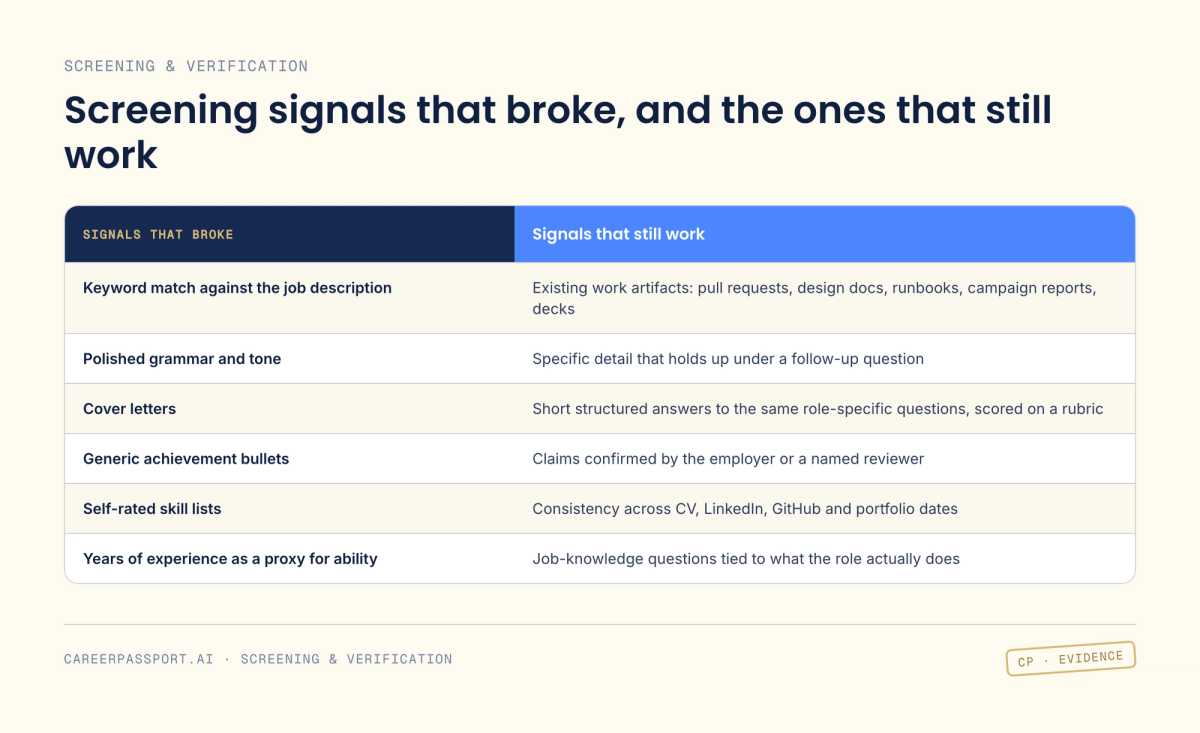
The research backs the right-hand column. A 2023 review by Sackett, Zhang, Berry and Lievens summarising their 2022 meta-analysis estimates operational validity (how well a method predicts job performance) at .42 for structured interviews, .40 for job knowledge tests and .33 for work sample tests. Unstructured interviews come in at .19 and years of job experience at .07.
What does an evidence-based screening workflow look like?
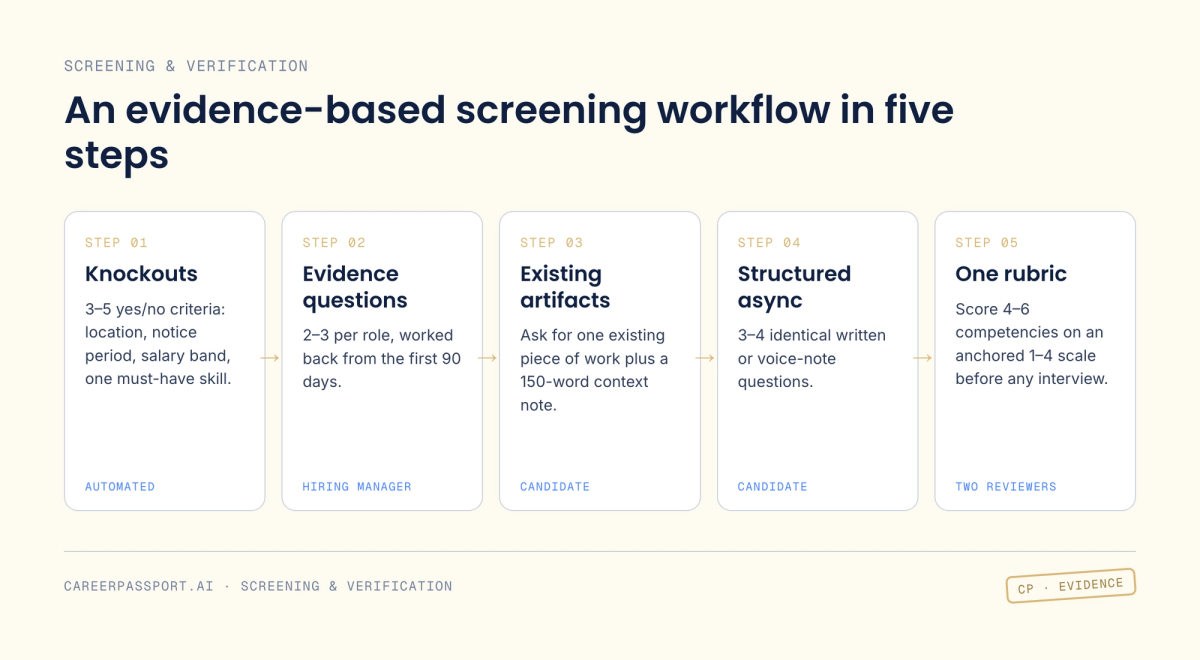
Five steps, set up once per role and reused.
- Write 3–5 knockout criteria. Knockouts are binary requirements that end an application if unmet: work location or relocation, notice period, the salary band in LPA, one non-negotiable skill. Keep them few and truly yes/no. Anything you would argue about belongs in scoring, not knockouts.
- Choose 2–3 evidence questions for the role. Work backwards from what the hire must do in the first 90 days. For a hypothetical payments backend role: "Show us a change you shipped to a system under production load," and "Show us a technical decision you later reversed, and why." For a hypothetical performance marketer: "Show us a campaign report where you cut spend on something that wasn't working."
- Ask for artifacts that already exist, not new take-homes. Most professionals have a trail of work: code diffs, incident write-ups, decision notes, dashboards, decks, published writing. Asking for one existing piece plus a 150-word note on context and trade-offs costs the candidate minutes, not a weekend. Tell them to remove confidential details. Under India's DPDP Act, Section 6(1), consent must be limited to the personal data necessary for the specified purpose, so ask only for what you will actually assess.
- Add 3–4 short structured async questions. Same questions for every candidate, answered in writing or a two-minute voice note. Push for specifics: what you did versus what the team did, what went wrong, what you would do differently. AI can produce a fluent answer, but it cannot supply the details of a project only the candidate worked on, and those details are what a follow-up probes.
- Score everything on one rubric before anyone interviews. Pick the 4–6 competencies the role needs (for example judgment, execution, communication, expertise) and anchor a 1–4 scale for each with a written description of what a 1 and a 4 look like. Two reviewers score borderline candidates independently, then compare.
How do you screen 500+ applications without reading every CV?
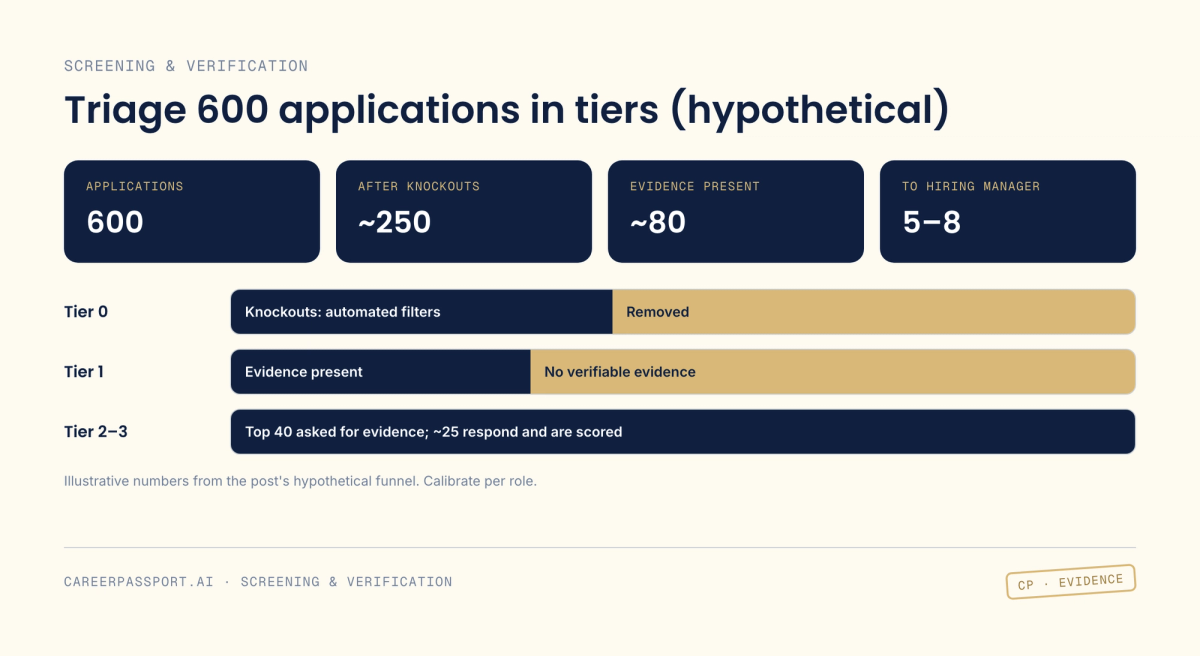
Triage in tiers, so effort grows only as the pool shrinks. Here is a hypothetical funnel for a role that draws 600 applications:
- Tier 0: knockouts (automated). Location, notice period and salary band filters might leave around 250.
- Tier 1: evidence present (under a minute each). Has the candidate linked anything verifiable, such as a repo, portfolio, publication or named project? Perhaps 80 remain.
- Tier 2: evidence request. Send the top 40 the artifact request and async questions. Expect some not to reply; that is itself a signal of interest.
- Tier 3: rubric scoring. Score the 25 or so who respond. Send the top 5–8 to the hiring manager with the evidence attached.
The hiring manager reads eight evidence packs, not 600 CVs. Treat these numbers as an illustration and calibrate them per role.
How do you pre-screen software engineers without a take-home test?
Ask for a merged pull request or diff they are proud of, with a short note: what problem it solved, what alternative they rejected, what a reviewer pushed back on. Engineers whose work is all behind an NDA can share a redacted design doc or describe a production incident they handled, with timestamps and their role in it.
Then make the first call a 20-minute walk-through of that artifact. You learn more from "why did you choose this queue over that one?" on real code than from a contrived four-hour exercise, and you don't ask a candidate with a full-time job to give up a weekend.
How does this reduce interviews per hire without lowering the bar?
Most extra interview rounds exist because the first rounds were spent discovering basics: can this person actually do the work they claim? When expertise and communication have already been checked against evidence, interviews shift from discovery to confirmation. The first conversation starts at "walk me through this decision," not "tell me about yourself."
Keep the interviews structured too. The gap between structured (.42) and unstructured (.19) interviews in the Sackett estimates is large. Use the same rubric across rounds and give each interviewer a different competency to probe, so rounds stop repeating each other.
How CareerPassport fits into evidence-led screening
CareerPassport is built around this workflow. The hiring manager writes one brief, and CareerPassport turns it into a hiring blueprint: technology requirements, expertise level, and an evaluation matrix chosen from nine competencies (Reasoning, Prioritization, Judgment, Expertise, Execution, Initiative, Communication, Collaboration, Alignment).
An agent then runs the role. It draws candidates from the company's own database, recruitment partners and CareerPassport profiles, approaches them, collects evidence, and returns a shortlist that is cleared to meet. The evidence is gathered before any interview, and on CareerPassport every claim is confirmed by the organisation named on it.
The hiring manager stays in control: for each candidate on the shortlist, they can invite, reject, or view the evaluation summary. Recruitment agencies and independent recruiters can run the same evidence-first process across their own mandates through CareerPassport for recruitment partners.
If your inbox is full of CVs that all read the same, book a free 30-minute demo and see what a shortlist built on evidence looks like.